


 119 / 812

24th European Congress of Psychiatry / European Psychiatry 33S (2016) S72–S115
S115
intervention the 16 young people participating in the program
experienced a mean weight gain of 1.8 kilograms, and a mean
increase inwaist circumference of 0.1 centimeters. The participants
were followed up for two years after initial referral.
Methods
During the two-year follow-up, participants had con-
tinuing access to an in house gym and weekly cooking groups, but
without the same intensity of follow-up. Two year follow-up data
were obtained from 11 participants form the original cohort.
Results
Mean weight gain at two-year follow-up was 0.90 (SD
8.7) kilograms, and this difference was not statistically significant
[
t
(10) = 0.3, NS]. Waist circumference decreased by 0.7 (SD 7.7)
centimeters, which was not t statistically significant [
t
(10) = 0.3,
NS]. Nine of the participants (82%) did not experience clinically
significant weight gain two years after initiation of antipsychotic
medication.
Conclusion
This two-year follow-up data demonstrated that it is
feasible to prevent weight gain in youth with first-episode psy-
chosis over the first two years of treatment.
Disclosure of interest
The authors have not supplied their decla-
ration of competing interest.
http://dx.doi.org/10.1016/j.eurpsy.2016.01.108Others
FC105
Differences between countries in
adult acute psychiatric
hospitalization: Clinical features and
drug prescription in Spain and the
United States of America
L. Gonzalez-Blanco
∗
, S. Bestene-Medina , E. Torio-Ojea ,
I. Abad-Acebedo , J. Rodriguez-Revuelta , G. Paniagua-Calzon
Servicio de Salud del Principado de Asturias, Psiquiatría, Oviedo,
Spain
∗
Corresponding author.
Introduction
Diverse prescription patterns and differences in
length of psychiatry inpatient stay among European and American
countries have been reported
[1,2] .Objectives
To describe and compare clinical features and drug
prescriptions in two Acute Psychiatric Units from Spain and USA.
Methods
Cross-sectional and comparative study. Sample: 73
inpatients from Reno (USA-Inpatients) and 65 from Oviedo (Spain-
Inpatients) admitted to public Adult Acute Psychiatric Unit over a
two-month period. Sociodemographic/clinical data and drug pre-
scription were collected.
Results
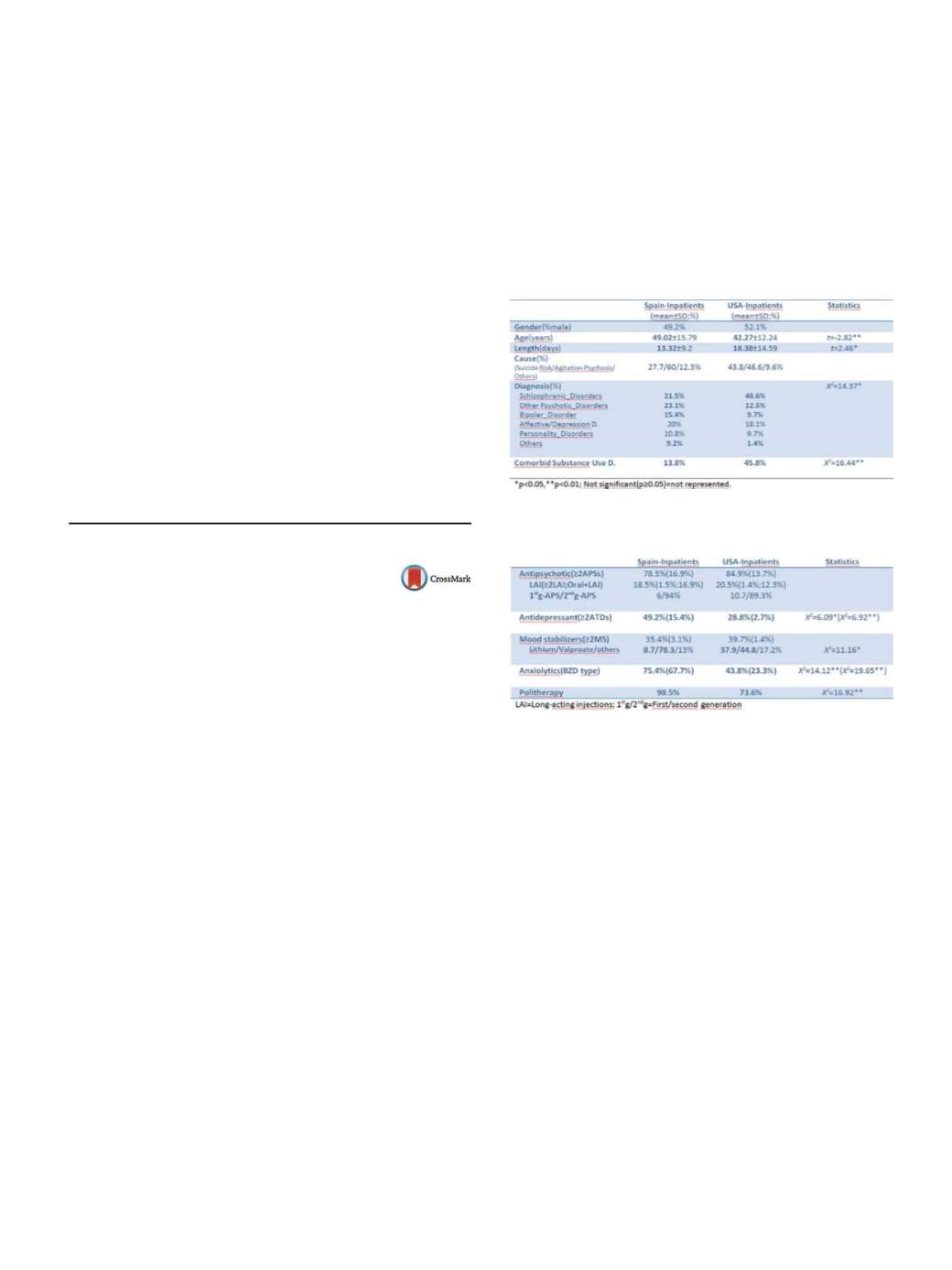
Sociodemographic/clinical comparison
( Table 1 )and
drug prescription differences
( Table 2 ) are shown.
No significant differences in antipsychotics’ prescription except for
the most frequently used [risperidone in Spain (36%)/ziprasidone
in US (19.6%), Chi
2
= 39.7**].
Conclusions
(A) Psychiatric inpatients in US are younger, have
longer hospitalization, show more comorbid substance use disor-
der and differ from Spanish inpatients in frequency of diagnostic
categories (schizophrenic disorders represent a larger proportion).
(B) Inpatients in Spain usually receive polytherapy, and are more
frequently treated with antidepressants and anxiolytics, especially
benzodiazepines. In contrast, USA-Inpatients take lithium more
often
[1,2] .Table 1
Table 2
Disclosure of interest
The authors have not supplied their decla-
ration of competing interest.
References
[1] Bitter, Chou, Ungvari, et al. Prescribing for inpatients with
schizophrenia: an international multi-center comparative
study. Pharmacopsychiatry 2003;36(4):143–9.
[2] Auffarth, Busse, Dietrich, et al. Length of psychiatry inpatient
stay: comparison ofmental health care outlining a casemix from
a hospital in Germany and the United States of America. German
J Psychiatry 2008;11:40–4.
http://dx.doi.org/10.1016/j.eurpsy.2016.01.109